

National Law Library Fellows Program
Established in 2000, the University of Arizona Law Library Fellows Program has been a premier experiential training ground for aspiring law librarians. Now, thanks to a generous grant from the U.S. Institute of Museum and Library Services, have been able to create five (5) detailed Handbooks, consolidated into three (3) separate online volumes, to help you design, create, and launch a fellows program, too—one that meets your institution's capacity and needs.
Additionally, we at the Daniel F. Cracchiolo Law Library are available for consultation and guidance as you embark on this journey. We know the challenges you will face, including funding, as we have faced them, too. Our profession cannot rely on just a few institutions to recruit, educate, and give experience to the next generation. We all have a role to play. Imagine the impact we can have, collectively, if we each host a fellow—or even if we each host a few every few years!
Our National Law Library Fellows Program started as a project to hire and place law library fellows at institutions across the country; the host institution would reimburse the University of Arizona for the cost of the fellow (salary, fringe, and LIS tuition). However, when IMLS funding was eliminated in Spring 2025, this plan came to a screeching halt and we pivoted to figuring out a way to help law libraries launch their own fellows program. The result is an expanded opportunity for law libraries of all types—academic, government, and private—and for MLIS students around the country. Here is the expanded set of handbooks we created to stimulate the creation of fellowships more broadly:
Image
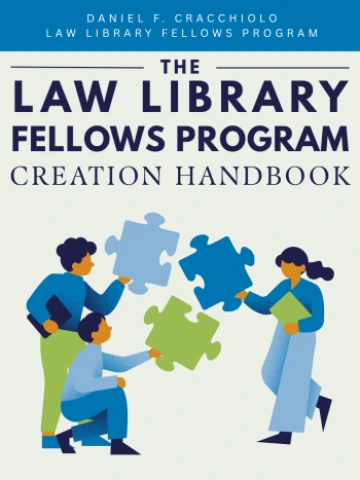
Guidance for Administrators & Supervisors | Image

Fellowship & Career Guidance for Fellows | Image

Guidance for Mentors & Mentees |
Additionally, Cas Laskowski and Zanada Joyner's textbook, Introduction to Law Librarianship, with a Foreword by Teresa Miguel Stearns and chapters from dozens of colleagues across the country and across library types, provides excellent introductory information touching on all aspects of law librarianship practice. Also, a white paper focusing on law library skills is forthcoming.
Our Fellows Program director (Cas) and law library director (Teresa) are available for consultation as you plan your fellows program.
Please join us in educating the next generation of law librarians!
Benefits of Creating a Fellowship &
Hosting a Fellow
By creating a fellowship and hosting a law library fellow, the host library receives:
- Assistance from Emerging Professionals. A law library fellow can work in your library the hours per week and as the length of time that makes sense for your library, allowing them to contribute meaningfully to your library’s mission and perform the professional tasks that you determine are needed in your library.
- Flexible Commitment. You may host a fellow whenever there is a candidate in your area and your time and resources allow.
- Tailored Program Support. From these comprehensive handbooks to personalized consultations, we are committed to providing you with individualized guidance and support, sharing with you tips best practices from our well-established and successful fellows program, which will allow you to seamlessly and easily integrate a Fellow into your library.
By hosting a law library fellow, the host library facilitates:
- Education and Recruitment. Through your provision of real-life experience, mentorship and professional development, you are cultivating the next generation of law librarians and reducing barriers to entry into the legal information field.
- Diversification. You are fostering inclusivity and innovation, which will help remedy the homogeneity and stagnation within the legal information field.
- Investment in Local Talent. Your fellowship, including financial support, training, and mentorship of emerging professionals, is an investment that will help create a robust pipeline of talented professionals in the legal information industry.
Benefits of Becoming a Fellow
By joining the program, law library fellows attain:
- Expanded Horizons. You will discover new pathways to the legal information profession. We encourage people with any level of legal education (e.g., Juris Doctor, Master in Legal Studies, Bachelor of Arts in Law, Paralegal certification) or prior legal experience to seek out a fellowship. If you don’t know where to start, reach out to us and we can try to connect you with a law library in your geographical area. We also encourage individuals with education and expertise in technology, data science, or foreign languages—all in high demand in law libraries—to apply.
- Real-World Experience. You will work alongside seasoned professionals in various law library departments, where you will carry out projects tailored to your specific career goals, allowing you to gain invaluable insights and practical skills.
- Financial Support. You will receive financial support—such as a salary, fringe benefits and potentially full or partial tuition remission for MLIS courses—to fuel your educational journey.
- Professional Guidance and Development. Participating in a fellowship as a student will afford you individualized guidance, mentorship, and resources to enhance your learning and career prospects. Some benefits might include: a law library mentor throughout the program; AALL student membership with two career-related Special Interest Section memberships; specialized career planning guidance; law-library specific course recommendations; and job search guidance.
- Connections. You will build lasting relationships with local mentors and peers.
Contact us
For more information, prospective fellows and libraries can contact:
- Cas Laskowski, Fellows Program Director
- Teresa Miguel-Stearns, Law Library Director
This project was made possible in part by the Institute of Museum and Library Services, Grant 254857-OLS-23. The Institute of Museum and Library Services is the primary source of federal support for the nation's libraries and museums. We advance, support, and empower America's museums, libraries, and related organizations through grantmaking, research, and policy development. IMLS envisions a nation where individuals and communities have access to museums and libraries to learn from and be inspired by the trusted information, ideas, and stories they contain about our diverse natural and cultural heritage. To learn more, visit www.imls.gov and follow us on Facebook and Twitter.